Wikipedia: the backbone of generative AI
Founded in 2001, Wikipedia is a collaborative online encyclopaedia with more than 62 million articles across over 300 languages. Its longevity, structure and open-access model have made it, almost by default, one of the most heavily used sources for the large language models (LLMs) powering today’s AI assistants.
A study by Profound, based on 680 million citations analysed between August 2024 and June 2025, delivers a clear finding: Wikipedia accounts for 47.9% of ChatGPT’s top-ten reference sources — more than the other nine combined. Each tool has its own hierarchy, however. Google AI Overviews and Perplexity lean more heavily on Reddit (21% and 46.7% of their top sources respectively).
In January 2026, the Wikimedia Foundation formally announced that Meta, Amazon, Microsoft, Perplexity and Mistral AI are now paying customers of Wikimedia Enterprise, the commercial product giving them large-scale, real-time access to Wikipedia content. Google, a pioneer of this arrangement since 2022, had led the way.
This is no coincidence. Wikipedia has three characteristics that LLMs particularly value:
- Systematic content structuring, with verifiable citations and interlinked articles.
- Machine readability, enhanced by Wikidata and DBpedia, which transform encyclopaedic content into knowledge graphs that AI engines can query directly.
- Perceived editorial authority: research shows that retrieval-augmented generation (RAG) systems using Wikipedia significantly reduce hallucination rates.
What Wikipedia is — and what it isn’t
The first mistake is treating Wikipedia like any other content channel. It is a collaborative encyclopaedia governed by a volunteer community of tens of thousands of active editors, applying strict rules. Ignore how it works and the consequences are public: deletions, warning banners visible to all, or blacklisting.
Notoriety: a misunderstood criterion
Wikipedia’s first criterion for inclusion is not an organisation’s size or importance, but its documented notoriety — meaning the quality and volume of independent coverage it has received.
For a page to be created or maintained, the subject must have received substantial, independent coverage from credible media: major national newspapers, recognised trade publications, newswires. A company cited in several AFP dispatches or multiple Financial Times articles meets this standard. A well-established regional business with no national media presence generally does not.
This is a critical point: notoriety in Wikipedia’s terms means proven media coverage — not sector recognition or commercial standing.
Neutral point of view: the cardinal rule
Wikipedia is written to a strict neutrality standard. Promotional phrasing, superlatives and slanted framing have no place on the platform. What communications professionals consider legitimate brand language — “market leader”, “innovative approach”, “committed player” — will be removed by editors as a matter of course.
Secondary sources: the only currency that counts
To have content accepted or amended on Wikipedia, it must be sourced with independent publications. Explicitly excluded:
- Company press releases.
- Blog posts or opinion pieces signed by the organisation’s representatives.
- Corporate website pages, LinkedIn biographies or sales materials.
- Podcasts, interviews or conference appearances.
Building a Wikipedia presence starts, above all, with a media relations strategy. Without independent press coverage, there is no Wikipedia.
Conflict of interest: the rule nobody reads
Anyone paid to work on a subject — employee, consultant or agency — is treated by Wikipedia as having a conflict of interest (COI). This does not prohibit contributing, but it imposes two obligations: explicitly declaring the affiliation, and not editing articles directly.
Proposed changes must go through the article’s talk page and wait for an independent contributor to review them.
Wikipedia’s volunteer editors are particularly alert to any attempt to circumvent this. An account created under a company name, a first edit made directly to its own page, or text that reads like a press release: all of these trigger closer scrutiny, and often immediate deletion.
The classic mistakes
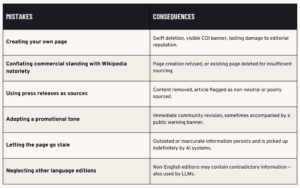
Several recurring errors come up when organisations approach Wikipedia without preparation.
When a page isn’t yet possible: legitimate
routes in
Not every organisation has, right now, the body of media coverage needed to justify a dedicated Wikipedia page. That is not a dead end — it is a starting point.
There are alternative strategies, fully compliant with platform rules, that allow organisations to build a progressive Wikipedia presence, accumulate editorial credibility, and begin influencing AI-generated answers at the same time.
Contributing to existing sector pages
The barrier to contributing to an existing page is considerably lower than creating a new one. Pages such as “Online banking”, “Information and communications technology”, or “Renewable energy” are valid entry points, provided contributions are factual, sourced and neutral.
This kind of engagement has a dual benefit: it progressively builds a credible editing history on the platform — a positive signal to the community — and creates connections between the brand and encyclopaedically recognised subjects.
Executive pages: often more accessible
Individuals more frequently meet Wikipedia’s notoriety criteria than organisations do, through sector awards, appearances at major conferences, or recognition in reference publications. Creating a page for a company’s founder or CEO is often a faster route than the corporate page.
The advantages are twofold: indirect visibility for the organisation through association with its leadership, and a personal branding boost that feeds AI responses on name-based queries.
Creating or enriching methodological pages
If an organisation originated a method, concept or technology that has received independent coverage, creating a dedicated encyclopaedic page for that approach — distinct from the corporate page — is legitimate and often welcomed by the community. The Wikipedia page for the Agile method, for instance, references multiple companies including Motorola and IBM.
Contributing research data to existing articles
Organisations that produce studies, barometers or market data can cite these findings in Wikipedia articles covering their sector — provided the sources are independent and the data has been picked up by third-party media. This positions the organisation as a reference in its field while adding genuine value to the encyclopaedia.
Building citation authority
One of the most durable strategies is ensuring that the sources Wikipedia recognises as credible write regularly about the organisation. This is earned media logic applied to the Wikipedia ecosystem: being cited by the sources Wikipedia cites means entering the circuit of encyclopaedic legitimacy — and, by extension, that of AI systems.
What organisations can legitimately do
A Wikipedia strategy is not a strategy for working around the rules. It is a strategy for working with them. The following actions fall within the legitimate scope of communications teams.
Audit what exists
Before doing anything, map the organisation’s current Wikipedia presence: is there a page? Is it up to date, well sourced, free of warning banners? Which other pages link to it? Check other language editions too. It is also worth querying AI tools directly — ChatGPT, Gemini, Perplexity — to see what they produce on the organisation, and to assess how much of that draws on Wikipedia.
Assess the available press corpus
Gather the independent press articles covering the organisation. If the corpus is thin, the priority is to build it first through targeted PR work: interviews in reference media, contributions to recognised trade publications, coverage of significant events.
Submit proposed changes through proper channels
If a page exists and needs corrections, the right approach is to create a Wikipedia account, declare the affiliation explicitly, then submit suggested changes via the article’s talk page with the COI banner attached. Independent contributors then review and decide whether to accept or reject. The process is slow — sometimes weeks or months — but it is the only approach that holds.
Consider a page if the criteria are met
If the organisation has a solid body of independent coverage, page creation can be pursued through the Articles for Creation (AfC) process, which submits the draft to community review before publication. The bar is high — correct wikicode, quality sources, strictly neutral tone — but it is the official route for contributors with declared interests.
Think about Wikidata as a complement
Wikidata is Wikimedia’s structured database — more open, more accessible to contributors with declared interests, and directly used by AI engines. Even without a Wikipedia page, maintaining an accurate and complete Wikidata entry improves how AI tools identify and describe an organisation. It is an under-used lever with low risk and real potential.
Monitor continuously
Wikipedia is a living resource: pages can be edited at any time by any contributor. Organisations with a page need to monitor it regularly.
In short
Wikipedia is not a communications channel. It is an encyclopaedic infrastructure whose editorial rules were designed specifically to resist promotional logic. Any attempt to work around them is visible, documented, and can leave a lasting mark.
For organisations willing to play by those rules, however, the opportunity is real. Wikipedia is one of the few places where a company can, legitimately and systematically, shape what AI systems say about it.
The Editorialist helps communications directors structure their Wikipedia presence: editorial audit, identification of a usable press corpus, drafting in compliance with platform rules, change monitoring and AI tracking. An approach rooted in our journalistic DNA.
Talk to our experts