What happens to your company’s reputation when no human ever clicks through to read it? While conventional search engines such as Google, Yahoo, or Microsoft Bing are slowly abandoned, generative AI engines are rapidly growing to be the most used research tools by investors, journalists and customers to find or compare companies. Indeed, according to Brunswick’s 2026 US Investor Survey, 54% of investors now consider GenAI moderately to very important to their research process, and 42% rank it among their top tools for conducting deep dives into new investments.
As GenAI use becomes prevalent, integrating Generative Engine Optimisation (GEO) into corporate content strategy is no longer optional. It raises a fundamental question for corporate communications directors: how do you shape a company’s narrative when the audience reading it is increasingly a machine deciding what to cite?
What GEO actually is: a reminder
Generative Engine Optimisation, or GEO, is the practice of shaping content and brand presence so that AI systems like ChatGPT, Claude, Gemini, and Google’s AI overviews retrieve, cite, and accurately represent a company when generating answers to user queries. The term was formally introduced in the paper “GEO: Generative Engine Optimisation” published by Princeton University in 2024. The paper proposed GEO as a black-box optimisation framework to help content creators improve their visibility in generative engine responses, and introduced a benchmark for evaluating that visibility across diverse queries and domains. In other words, this is a documented shift in how information retrieval works, not a trend manufactured by digital agencies.
The practical difference from traditional SEO is significant. Whereas SEO optimises ranking on a results page, GEO is about earning citations inside an AI-generated answer. Success in SEO is measured by page rank, while success in GEO is measured by citation frequency and accuracy. That distinction changes the stakes considerably: in traditional search, being on page one still gave a brand a chance at being found, but in AI-generated answers, a company may be one of only a handful of cited sources, or left out of the conversation entirely.
Why GEO is essential to communications teams and large corporations
For communications teams, GEO matters because it closes the gap between technical SEO and narrative PR. Keyword tricks, storytelling, and third-party validation that PR has always produced now directly shape how a brand is described in AI answers. That comes with a real reputational risk, since an AI pulling from an outdated blog post or a disgruntled former employee’s post can turn into the “truth” the user receives, and unlike a factual error on a company’s own site, a misrepresentation embedded in an AI answer often can’t be simply corrected.
Establishing a clear brand image is also harder than in classic search. Generative systems compress nuanced source materials into a single output, flattening differences and favouring familiar brands or mainstream consensus, meaning that a company’s carefully built narrative can be diluted or dropped entirely. That makes owned content high-stakes. As JCI Worldwide notes, the digital footprint a company leaves today is the training data for the AI of tomorrow, meaning every press release, byline, and mention becomes raw material that AI systems can cite, quote, or misread.
Examples of a GEO analysis and cross-sector comparison
Running DHL and HSBC through Mangools’ AI Search Grader exposes just how differently GEO plays out across sectors, and the size of the competitive gap in each case tells its own story.
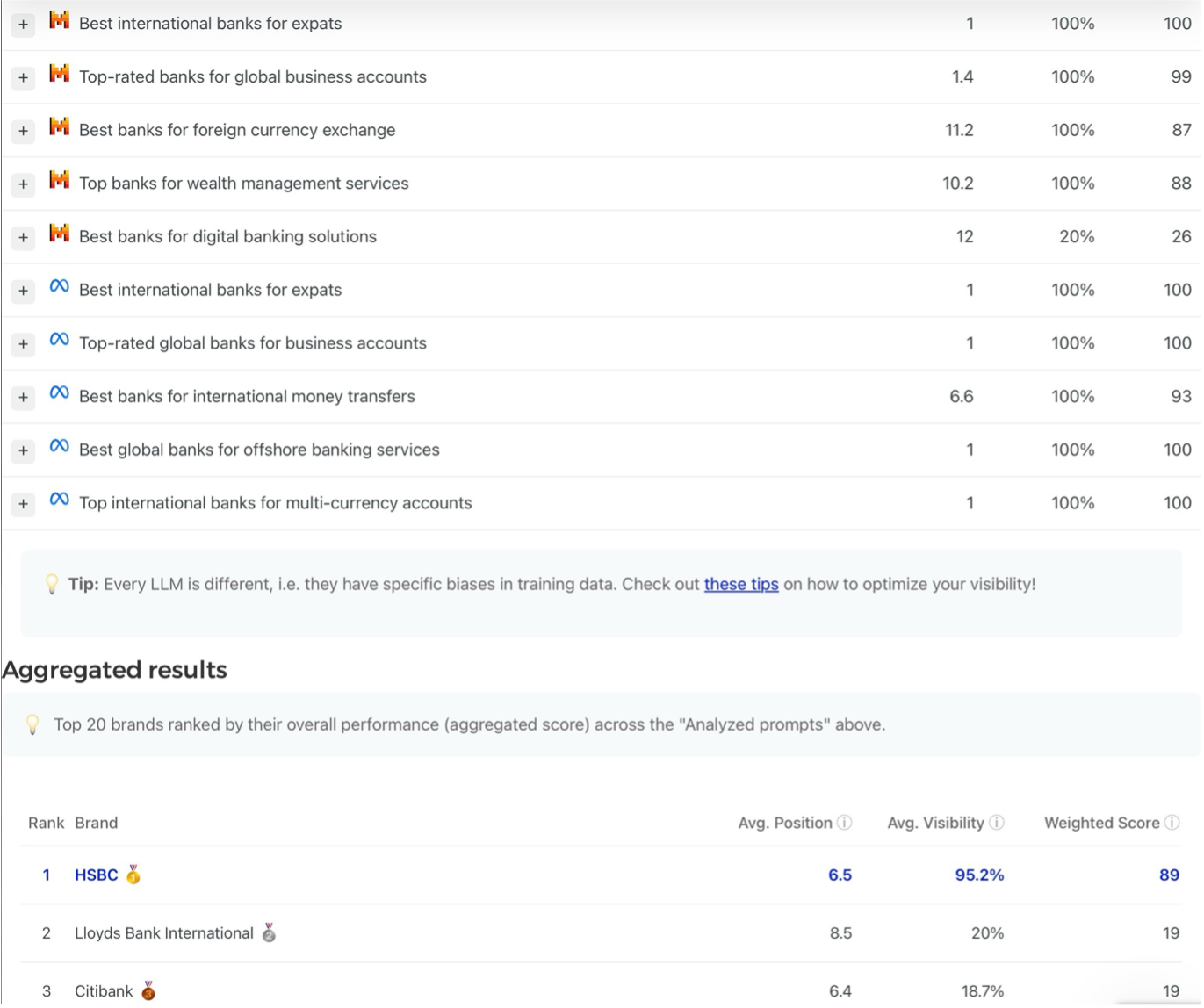
In banking, HSBC’s dominance is close to total: a 95.2% visibility rate and a top-ranked position gave it an AI Search Score of 89 against Lloyds Bank’s 19. Lloyds appeared in only 20% of prompts compared to HSBC’s near-universal presence. HSBC has a structural monopoly on AI attention, being effectively the default answer to almost any banking-related prompt tested. Lloyds is functionally invisible in comparison.

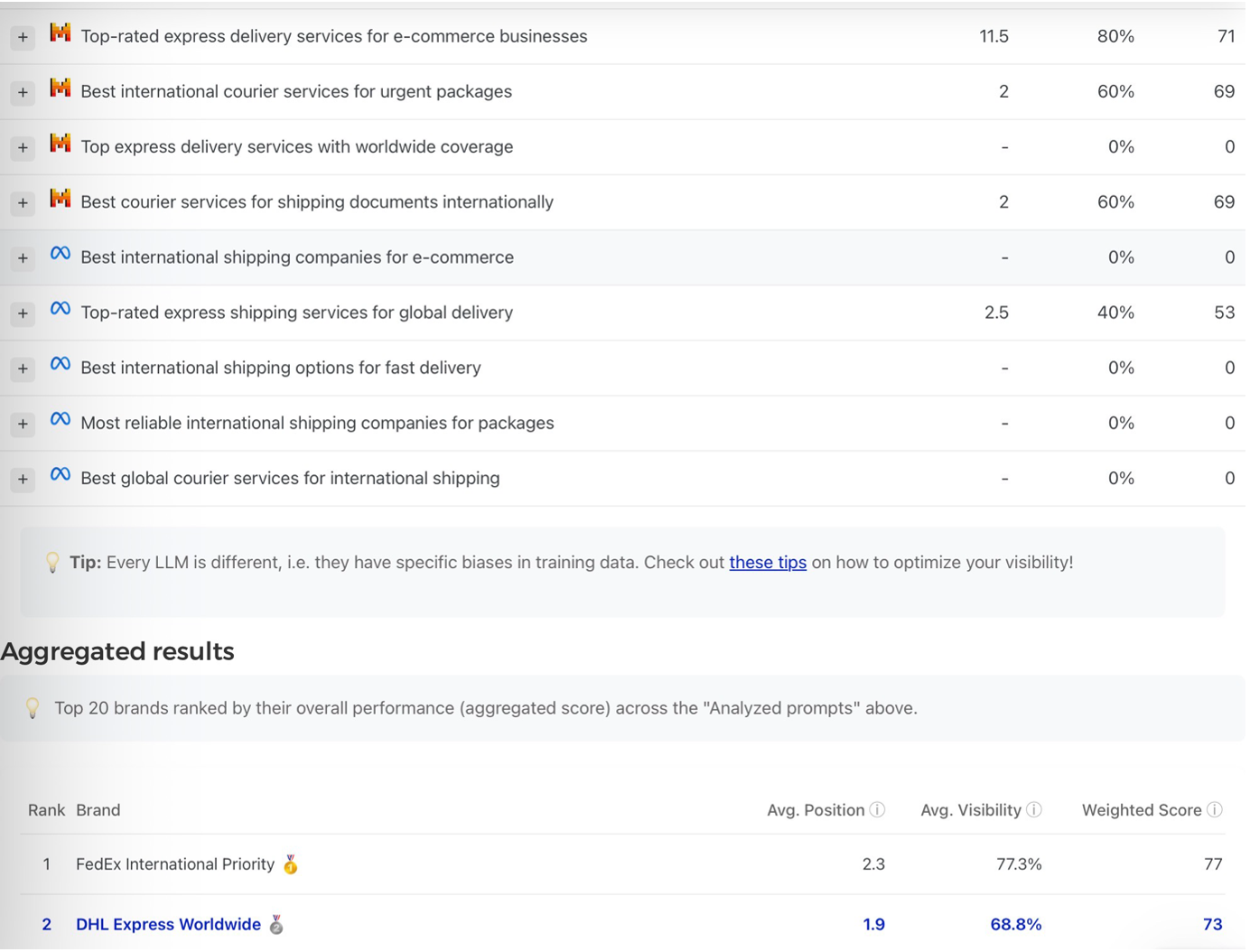
In logistics, the gap is a fraction of that size: DHL’s score of 73 sits just four points behind FedEx’s 77, with UPS a further four points back at roughly 69. All three brands cluster within a single-digit band, and DHL actually outranks FedEx on average position (1.9 vs. 2.3), even while trailing slightly on overall visibility (68.8% vs. 77.3%), meaning DHL wins the prompts where it appears, but appears in fewer of them.

That difference in gap size implies two very different GEO strategies
- For HSBC, the priority is protecting an already dominant position, since a 70-point lead of this size suggests the brand has become deeply embedded as the AI’s default trusted global bank reference, likely built up over years of consistent third-party citations, regulatory coverage, and earned media. The risk for a leader like HSBC is complacency: AI training data shifts, and a rival investing heavily in structured, citation-friendly content could start closing that gap faster than expected.
- For DHL, the four-point gap to FedEx is much more actionable because it sits in a genuinely contestable range. DHL needs targeted GEO work on the specific prompt categories where it currently drops to 0% visibility (like “top express delivery services with worldwide coverage” or “best international shipping companies for e-commerce”), since closing just a few of those visibility gaps could realistically flip its ranking above FedEx.
The wider the competitive gap, the more GEO becomes about defending a narrative. The narrower the competitive gap, the more GEO becomes about winning specific, high-value queries one at a time.
What practical steps you should take towards GEO
Translating GEO research into practice starts with content strategy. The Aggarwal study found that Statistics Addition and Quotation Addition produced the strongest visibility gains across every metric tested, while old-school keyword stuffing consistently underperformed. It implies that content should be built around concrete, citable data points, specific figures, named studies with clear attributions, rather than marketing prose an AI would have to paraphrase.
Auditing the company’s AI footprint directly is the next step: systematically testing what ChatGPT, Gemini, and Perplexity actually say about the brand and checking accuracy, not just presence. As the DHL and HSBC data shows, visibility swings sharply by model and by prompt, and a hallucinated fact or outdated statistic can harden into an AI default answer with little chance of correction after the fact, making early detection far more valuable than damage control.
Prioritising the queries that function as real recommendations matters most. “Who” questions and head-to-head comparisons, where an AI’s answer effectively steers a decision. DHL’s results make the case for this: its visibility dropped to 0% on several comparison-style prompts while scoring perfectly on others, showing that gaps are often concentrated and fixable rather than systemic.
Finally, none of this works without a consistent, credible set of brand facts. If positioning and key claims shift across press releases, bios, and web copy, AI systems have less to converge on and may fill the gaps with outdated or third-party material instead. Consistency has to be engineered across every touchpoint a brand controls – media, speeches, bylines, FAQs, investor materials, site content – since each is a potential input into how AI describes the company.
GEO represents a real shift in how reputations are made.
It teaches us that concrete, citable content outperforms polished marketing copy, that visibility varies wildly by model and prompt, and that mistakes embedded in AI answers are hard to walk back. DHL and HSBC show what’s at stake in practice: a 70-point gap can mean total invisibility for a rival, while a 4-point gap might close with a few targeted fixes.
For communications directors, it adds a new arena to the job. Reputation has always meant shaping how a company is seen. Now, that shaping happens partly through an algorithm deciding what to cite. Directors who act on this early will gain a channel that works in their favour.
This is exactly where The Editorialist works. We help corporate communications teams build the content discipline that generative engines actually cite.
Talk to our GEO experts