
PR visibility no longer rests on media relations alone. Companies are publishing on their own channels, partnering with content creators, building recurring editorial formats, and fighting for a place in search results including inside generative AI tools.
It now runs on four complementary stages: create, validate, amplify, extend.
CREATE: produce content your ecosystem actually needs
The first stage is producing content that can feed the conversations already happening in your sector.
Journalists, analysts, content creators and decision-makers are looking for one thing above all: information they can’t find anywhere else. Exclusive data, proprietary studies, first-hand accounts, market analysis, domain expertise.
According to TopRank Marketing’s State of B2B Thought Leadership 2026 report, 67% of marketers rank proprietary research as the most effective format for building organisational credibility.
Executive visibility follows the same logic. Research from Edelman and LinkedIn found that 95% of decision-makers say thought leadership shapes their professional choices, and 67% of B2B buyers research a company’s leadership before a first conversation.
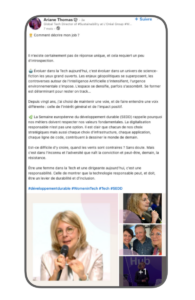
Some executives have turned LinkedIn into a genuine speaking platform. Ariane Thomas, Global Tech Director of Sustainability & Trustworthy AI at L’Oréal, is a case in point. Her posts on AI, organisational change and women in tech generate strong engagement and turn her into a visibility channel for her employer in her own right.
In practice, an executive who regularly shares their read on where the market is heading creates more speaking opportunities than a company that only communicates around institutional announcements.
Audio formats are reinforcing the same shift. Expert podcasts, interviews and themed series let companies tackle complex subjects in a more conversational register.
VALIDATE: earn recognition from outside the building
Once the content exists, the next challenge is getting it recognised by people outside the company.
Press coverage still matters here. It brings an external, independent viewpoint that lends credibility to a subject in the eyes of stakeholders.
Journalists’ expectations have shifted. Cision’s State of the Media 2025 and AMWgroup both found that 86% of journalists reject pitches that fall outside their beat, while 91% pay closer attention to pitches built on original data or research.
Personalisation isn’t optional any more. A pitch that works in 2026 ties a precise angle to a beat the journalist already covers, backed by a piece of exclusive data they don’t have.
This is the logic behind newsjacking: adding a data point, an angle or an analysis to a news story that’s already part of the public conversation.
A cybersecurity firm responding to a major breach by sharing data from its own observatory or client base is a good example. The goal isn’t to comment on the news it’s to add something to it.
AMPLIFY: get the message moving
Media coverage is a step, not a finish line. The next challenge is getting that coverage in front of the audiences who matter most.
Influencer partnerships now play a growing role here. TopRank Marketing’s B2B Influencer Marketing Report 2025 found that 85% of US B2B marketers now build influencer partnerships into their strategy.
Micro-influencers and sector specialists are drawing particular attention: smaller communities, but more specialised ones which tends to drive stronger engagement on technical or industry-specific subjects.
In B2C, Instagram and TikTok remain the main activation platforms. In B2B, LinkedIn keeps gaining ground and has become the default channel for expert commentary, sector studies and market analysis.
Paid amplification adds a further layer, scaling content that has already proven its pull with an organic audience.
Press relations are also taking on a growing role in generative search environments arguably the most structural shift of the past two years.
GEO (Generative Engine Optimisation) extends the scope of PR beyond human audiences. When ChatGPT, Gemini or Perplexity generate an answer on a given topic, they draw on content cited by recognised media outlets, reference publications or named experts. A company quoted in a major national newspaper or a leading sector report stands a better chance of surfacing in these answers than one that only publishes on its own channels.
The Reuters Institute has tracked a growing share of information access running through these answer engines, at the expense of direct traffic to media sites.
EXTEND: make visibility last
The final stage is extending how long content stays in circulation.
A study, an article or an interview can be reworked into several formats: a LinkedIn post, a newsletter, a short video, a carousel, a podcast episode, a conference talk. This isn’t about producing more — it’s about getting the same piece of expertise in front of several audiences, across several channels.
CEVA Logistics applies this consistently: expert articles, LinkedIn content, video formats and podcasts, all built around subjects like supply chain, sustainable logistics and shifts in the sector.

Employees are playing a growing role in this distribution too. Sociabble reports that employee-shared content generates eight times more engagement than content published solely by corporate accounts, and 78% of consumers say it influences their purchasing decisions.
Employee advocacy fits naturally into this picture: employees become an additional relay for the content a company produces.
It also responds to a measurable reality. Brandwatch‘s research shows that brands themselves account for a small share of the online conversation about their own name.
What this means in practice
Companies gaining PR visibility in 2026 aren’t publishing more. They’re publishing better, and actively managing how what they publish travels.
That comes down to a few concrete moves:
- Build content around real expertise
- Keep up a regular drumbeat of executive commentary
- Earn relays through media and trusted third parties
- Use influencer partnerships to extend reach
- Stretch the lifespan of content across formats
Public relations no longer stops at media coverage. It now shapes a wider visibility ecosystem — one where content, media, creators and employees all carry information further over time.
At The Editorialist, we help companies build the frameworks that connect editorial production, distribution and amplification.
Talk to our experts