How would you describe what you do today?
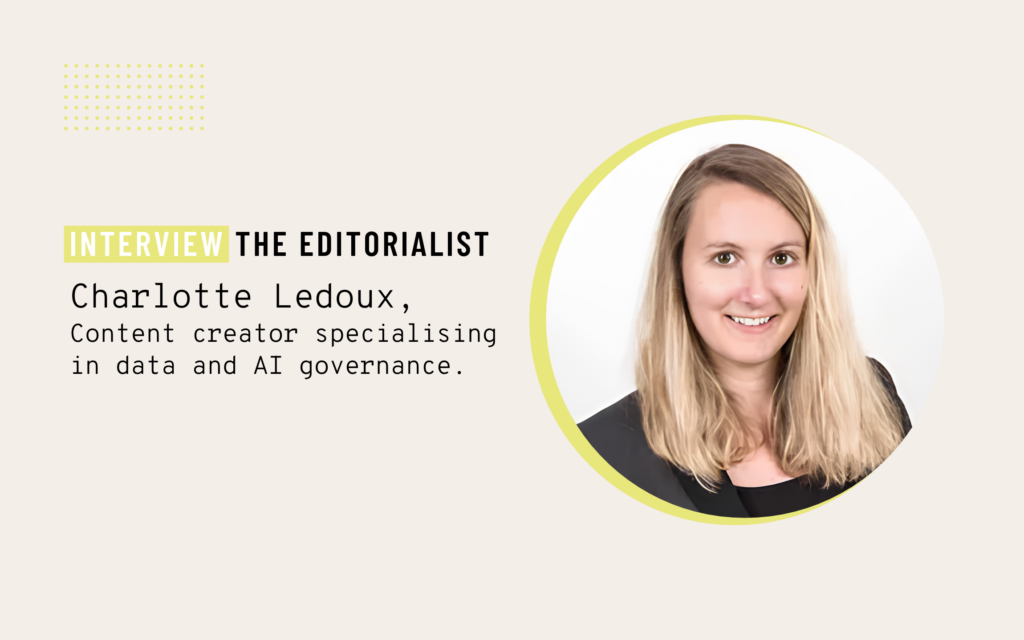
It’s fairly multi-faceted. I started out in data and AI consulting, then struck out on my own, first as a freelancer, registered as a sole trader. That’s when I began creating content on LinkedIn, in my niche: data and AI governance. It was never planned, but it grew without me really chasing it. I started posting around 2021, then in 2024 I wanted to diversify and launched my newsletter on Substack. Today I’ve gone from freelancer to entrepreneur: I took on a business partner, and we run both a consulting arm and a data-and-AI literacy arm, with games such as the Chief Data Officer Game. Over the past year or so, as my audience has grown, companies in the sector have started approaching me to sponsor posts, co-write the newsletter, or run webinars together. I’m increasingly trying to build long-term collaborations rather than one-off formats. It’s more solid, for them and for me, and it’s more interesting financially.
Why launch a newsletter on top of LinkedIn?
The trouble with LinkedIn is that the content is very short. There isn’t really room for nuance. I wanted to build a community that belonged to me more directly. There’s also a reassurance factor with a newsletter: if LinkedIn changes its algorithm tomorrow and my visibility collapses, the work I’ve put in doesn’t disappear. On Substack, I have people’s email addresses, so I’m already closer to them, and there’s a chat feature where I run Q&As with the community. I’m trying to move towards more direct interaction.
Do LinkedIn and Substack give you different things?
I think there’s a lot of overlap: most of my Substack subscribers come from LinkedIn. But I’m also noticing that a lot of people are getting tired of LinkedIn. It’s become a race for the biggest post, there’s more and more advertising, and a lot of AI-generated content. Substack still feels a bit more low-key, almost like the internet ten years ago: less advertising, more sincere writing. When I do collaborations with brands today, they’re as interested in my LinkedIn as in my newsletter, which lets me put together combinations that weren’t possible before. At the very start, I sold a LinkedIn post for €500, full stop. Today, it opens up far more possibilities.
Why did you switch your newsletter from French to English?
I originally wrote in French, it felt more natural. But after two or three issues, I was getting a lot of messages from people asking for an English version, because their company was international and they wanted to share my articles with teams on the other side of the world. After a few messages like that, I decided I wasn’t going to wear myself out producing two versions every time, so I switched to English. It also matches my actual audience: the US is my top country, with France in second place.
What’s the concrete business impact of this public presence?
I often tell fellow freelancers who are struggling to find clients that it surprises me, because I have a waiting list. I do no prospecting at all: my LinkedIn and my newsletter are my prospecting. I’ve never needed to send a message saying I was available for a project.
How do you manage brand collaborations?
At the very start, I let brands take the lead and propose things. I realised that wasn’t the best approach, for them or for my audience, because a brand tends to push its own vision, its products, its offers, without necessarily adapting to the audience. Now it’s the reverse: they explain their solution to me, and I’m the one who proposes the formats, the type of content, the visuals, with my own style rather than their logo and brand guidelines. It works far better this way, so I’ve become much more proactive in shaping the pitch.
Do you ever turn down partnerships?
Yes, of course. Sometimes because I feel it’s too far removed from my sector and my audience, and it would end up as an advert rather than content with real value. Sometimes it’s about price: if a brand wants to cut my rate by two-thirds, I tell them to come back when they have the budget. It’s not just a post, it’s carefully thought-through content that has an impact. Given my audience today, I have more reach than the page of most companies. So it isn’t free.
How do you see this B2B creator ecosystem evolving?
I think the real movement is happening internationally. I talk to other creators and we’re seeing the same kinds of collaborations. In France, on my specific subject, I feel like I’m almost the only one doing this for now, and a lot of my contracts come from companies that aren’t French. I think we’re right at the start of the wave.
You also wear an entrepreneur’s hat with Make Tools. Are there links between that activity and your brand partnerships?
Last year, with my business partner, we created a small game to introduce people to the Chief Data Officer role. We built it originally just because we thought it was fun. Today, the game is sponsored by Salesforce, which uses it at trade shows and events. It’s a Make Tools production that found its client that way, without us really looking for it.