You spent fifteen years at brokerages before going independent. How did that transition happen?
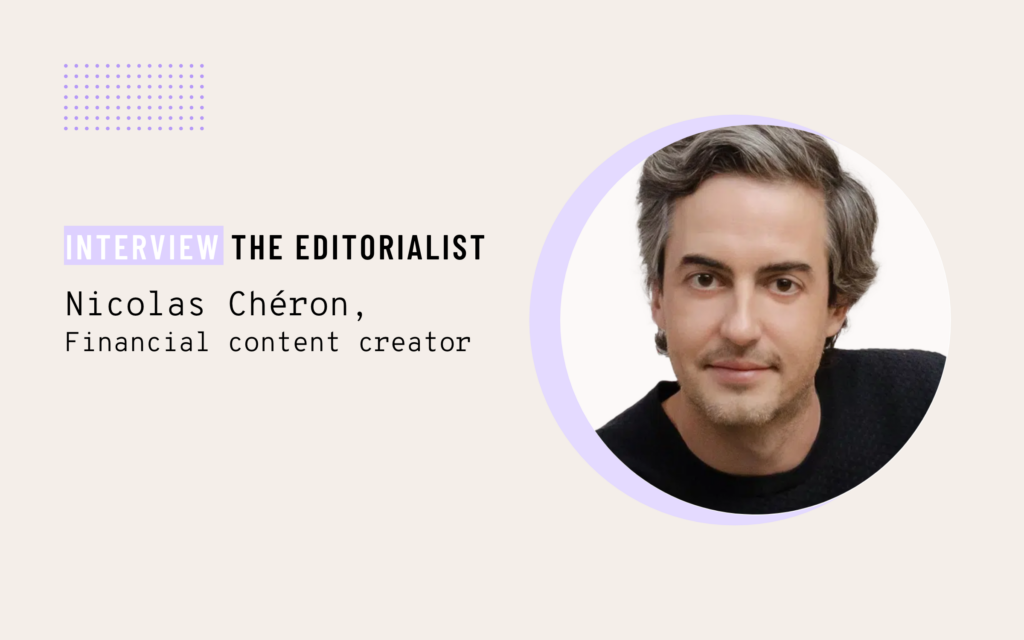
Nicolas Chéron : It was a path built from encounters and coincidences rather than one sharp decision. I started as an intern moderator on Fortuneo’s stock market blog in 2006, at a time when forums were the main place for private investors to exchange views on the markets. I followed the same instinct with every new platform: Twitter from 2010, YouTube in 2011-2012, LinkedIn shortly after. Covid accelerated something I could already sense: the rise of social media and the public’s growing appetite for the stock market created a real market for quality financial content, alongside pure entertainment. I saw my place in that.
What convinced you to go it alone rather than stay in-house at a brokerage or a financial website?
There’s a line I repeat often: a brand can’t sell itself. A company needs figureheads, content creators, faces to carry its message. That’s what major brands do with their campaigns. As I approached 40, with six social media accounts and more than 100,000 followers combined, I realised that staying tied to a single brokerage was limiting me. I have readers who are just starting out, others who want to invest in equities, metals or ETFs, who are looking for a trading platform or a wealth manager. Rather than represent a single player, I went out and approached the brands I’d used and rated for fifteen years, to propose becoming their partner.
How do these partnerships work?
I only sign annual agreements, renewed year on year, and I don’t change who I am for a partner. If a brand offers to triple its budget in exchange for three times the visibility, I say no: gold, for instance, will always stay a minor topic in my content calendar, capped at 12% of output, whatever budget is on the table. I also always keep two options live for each type of product, two brokerages, two physical gold platforms, and so on, and I won’t hesitate to recommend a competitor if a reader tells me it suits them better. I’m a customer of every brand I represent: that’s a condition I set for myself.
For the past two years you’ve also worked with major listed French companies. How do those collaborations differ?
They take the form of one-off features, in video or in writing, rather than year-long partnerships. With L’Oréal, we film in a studio, on their premises. With Engie, it’s live but online, with the chief executive answering questions from the chat, a kind of informal AGM. We’ve also done newsletters with Orange, Total and Sanofi. My role is to bridge the gap between executives, management committee members, and the end investor. It’s usually the brands that approach me first, but my name also travels by recommendation: Total pointed me towards Air Liquide, for example.
You describe what you do as a media outlet in its own right. What does that actually involve?
It’s no longer a one-person operation. Seven social media accounts, five hundred posts a month, reporting for every partner, video editing, hundreds of comments to manage across every platform. I have a team behind me. Anthony handles my website and my emails, Simon is my right hand, Alexandre runs Instagram, I work with an agency, Sherwood, on the large listed brands, another for video, and a third that built my website. I’m now at 465,000 followers across all platforms combined, with a million page views and close to 10,000 interactions a month. Two newsletters a month, no more than that, but dense ones, and I get a very strong open rate because I never send recycled content.
How is your content calendar built?
It’s constantly evolving, through iteration. I mix cold, evergreen, educational content with hot content reacting to the news: quotes, polls, explainer graphics, show teasers, ETF rankings. One of the formats that’s worked best is my wife’s portfolio, which I share every month under the name “Jacqueline DCA”. Two characters, Jean-Michel and Jacqueline DCA, have grown out of that recurring content to the point that some followers have created Twitter handles in their name.
How do you see the French financial content creator ecosystem evolving?
Social media usage has reached maturity, but on investing specifically, there’s still a wide-open road in France: we’re starting from such a low base that the number of investors could realistically double or triple over the coming years. The ecosystem is professionalising, the weaker creators are dropping out, the best are establishing themselves. And this role will carry more weight as trust in institutions and traditional media declines: people increasingly identify with individuals rather than with brands or newsrooms.
How do you measure that responsibility day to day?
By sourcing everything systematically. My charts come from the Times, Bloomberg, The Economist and Visual Capitalist, and that’s stated clearly on every post. I draw on research from the AMF (France’s financial markets regulator), Amundi and BlackRock, I read a lot of American analysts, and I always cite my sources. I was among the first to pass the responsible influence certificate, and I always display the advertising disclosure on my collaborations. The bigger the audience, the greater the responsibility.
One last question: are there any voices you follow closely on these topics, in France or elsewhere?
The person who carries the message best, to my mind, is Matthias Baccino. We work together via Trade Republic, where he remains a consultant, and he tackles substantive topics, financial education, pension funding, the French economy, with a rigour I follow very closely.