How would you describe what you do?
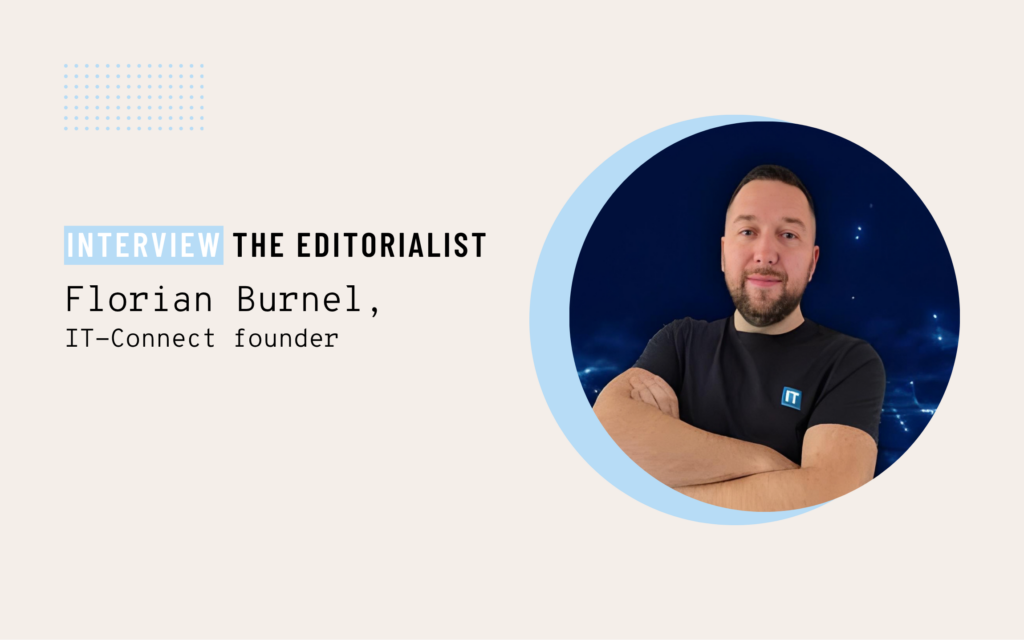
Florian Burnel : It’s genuinely hybrid, and it’s sometimes hard to place myself. I’m not keen on being called an influencer, because I created IT-Connect nearly fifteen years ago, back when influencers as a category didn’t even exist. The original idea was to share what I was learning, discovering and experiencing, through articles and videos. Over time, it drew an audience, and that attracted brands and publishers. I became an “influencer”, in inverted commas, almost by force of circumstance, but that was never the starting point. Either way, if I’m here today, it’s down to hard work and persistence.
How did IT-Connect start?
I was studying for an IT diploma and I was a bit bored in my first year. The one genuinely new thing for me was web development. I started building a first site, putting a few technical notes online, a bit like a hobby. A classmate and I began working on it together, and as traffic grew, we formalised things: it became IT-Connect in 2013. We kept creating content throughout our studies, right through to our master’s degree. After graduating, we went our separate ways, and I took a permanent job, but I kept working on IT-Connect in the evenings or before leaving for work in the mornings. Eventually, as demand grew, I decided to leave my job to focus on it full-time, supplementing that with training courses at schools and freelance work for companies.
And the YouTube channel?
That came around 2021, fairly on a whim, one morning. I grabbed my laptop and made a video about PowerShell, no frills, no proper microphone, diving straight into the subject. People liked the way I explained things, so I started improving it step by step: the microphone, the editing. There had been a handful of videos ten or eleven years earlier, just silent clips with no voiceover, but it was really that 2021 relaunch that built the channel. It now has more than 500 videos.
How do you choose your topics, and how do you split your time between articles and video?
I follow a huge number of sources: RSS feeds, Microsoft pages to catch the smallest change, projects emerging on GitHub. But these days I sometimes don’t even need to go looking for stories: open-source creators come to me directly to ask for an article or a video, because they know that coverage gives them visibility. The hardest part is prioritising: there are simply too many interesting topics.
To present a tool, I generally do both an article and a video, because some people prefer to read and others to watch, but that doubles the workload. I try to use AI to streamline it: I make the video first, get a transcript from it, and use that as the basis for the article. I polled my community on LinkedIn about this: some prefer one format, others find the two complementary, so I keep feeding both. I also started, about eighteen months ago, making short-form content for TikTok and Instagram, but it isn’t straightforward, because my YouTube videos run 15 to 20 minutes in landscape format, and condensing that into a one-minute portrait clip takes real adaptation work. Today I mainly use TikTok for news-style content, or to make people want to go and watch the full video on YouTube.
What role does LinkedIn play in your strategy, particularly given your dual presence between the IT-Connect page and your personal account?
I don’t really use LinkedIn for exclusive content: it’s mainly there to relay what I create elsewhere, the articles or the videos. There’s a story behind that dual presence: a few years ago, my personal account was getting a constant stream of connection requests, so I created the IT-Connect page and published everything there, leaving my personal account dormant. Over time, I realised I also needed to work on my own presence, because if IT-Connect ever loses momentum, there will still be Florian, who can keep putting things out. The IT-Connect page now has more than 150,000 followers, but I’m publishing more and more on my personal account too, sometimes relaying content, sometimes staggering posts between the two so they don’t go out at the same time.
What makes you want to accept a brand collaboration?
I filter heavily. If I don’t like the solution, I can’t see myself talking about it on camera. That alone accounts for three-quarters of the decision. It also depends a lot on the budget. If what’s on offer doesn’t match the work required, I turn it down, whatever the brand. I always make sure sponsored content stays a minority of what I publish, because if everything is sponsored, it loses its meaning. And I always ask for a demo: an hour on a video call so they can show me the solution and I can get at least a basic grasp of it. I never do this blind. If I can’t get a demo, I take the time to check whether other videos already cover it, and I do my own research. Even when there’s money on the table, keeping my credibility matters more to me than talking about just anything.
Are there any practices you refuse to take part in?
Recently, a client wanted a LinkedIn post using tactics I find borderline dishonest: asking people to comment a specific word to receive a link. I can’t stand that kind of practice, so I won’t impose it on the people who follow me. In that case, I told the client it would be without me. In the end, we did a post my way: there were fewer comments, inevitably, because people don’t comment if you don’t tell them to, but I dislike those manipulation tactics. Even so, the performance was good. My posts are simple, and I write them myself. For a client, I make a particular effort and everything is signed off with them, but I don’t spend half an hour agonising over how to game the algorithm.
What’s the business impact of your collaborations for brands?
Some brands tell me it’s good for their image and want to run collaborations regularly. I have several partners I work with almost year-round: an article a month, a video a quarter, that kind of rhythm. Others only need a single collaboration, because the product doesn’t change much in the meantime, which doesn’t mean it went badly. My newsletter wasn’t sponsored until recently: I’ve now added a sponsor slot as an additional revenue stream, and my long-standing partners have followed suit. I see that as a sign of trust.
How do you set your rates?
I have a media kit that summarises my channels, follower numbers and audience, but without rates, except for newsletter sponsorship, which is fixed-price. For everything else, the workload varies enormously: presenting a solution can take me a day or a week depending on what’s asked, and it’s the same for articles, ranging from an in-depth technical demo to a lighter editorial piece. I see big price gaps for comparable work, sometimes double from one creator to another. The market is still poorly benchmarked when it comes to valuing editorial work. On some requests, there just isn’t much of a reference point yet.
What kinds of brands work with you?
It’s quite varied, large companies and SMEs alike. I work, for example, with Synology, TP-Link and Specops Software, but also with Lockself, a Paris-based password manager, more on the SME side. There’s also a recent trend: I’m increasingly asked to showcase sovereign, French or European solutions, in the current climate.