What does your role at CEVA Logistics involve?
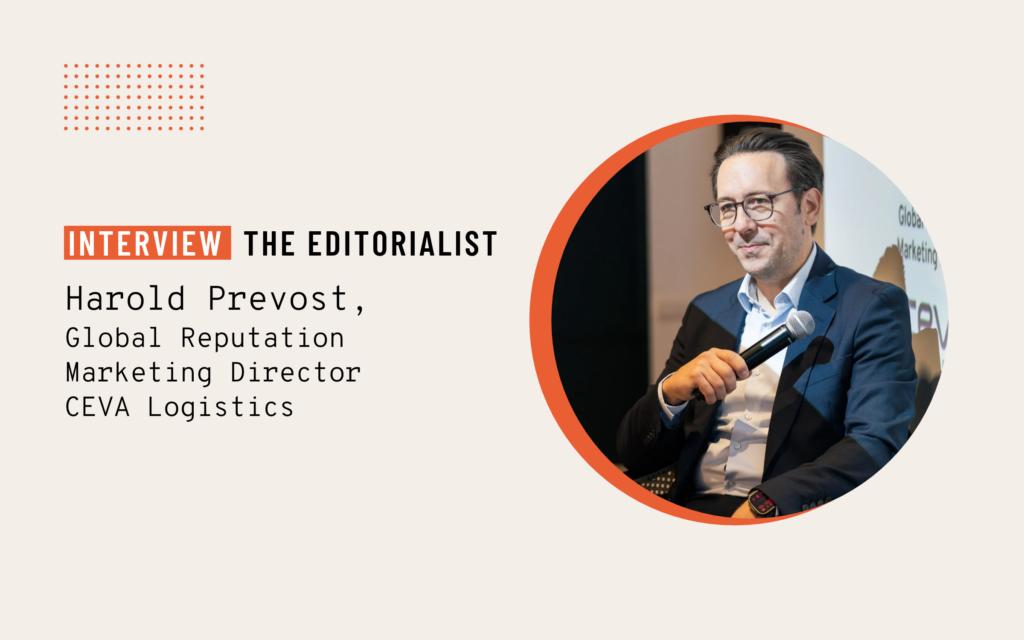
Harold Prevost: I’m fortunate to lead the team responsible for much of how CEVA Logistics presents itself to external audiences: our entire digital presence, the stories we want to tell and how we showcase our solutions and expertise. Our strategic aim is to demonstrate CEVA’s leadership in its field, which means there’s a lot of work to do on visibility and reputation. The second part of my role is lead generation: engaging with customers to open up new business opportunities. The two are closely linked, because in our industry, many decisions are driven by human factors. When choosing one logistics provider over another, our buyers, and even our prospective employees, don’t rely solely on factual, rational criteria. They need to feel that what the brand stands for aligns with their own values and expectations. It’s a new approach to marketing in logistics. CMA CGM acquired CEVA Logistics six years ago, and we’ve spent those six years rebuilding everything from scratch, from marketing to reputation.
Why is it so hard to stand out in your sector?
H.Prevost: In our industry, large logistics providers with a broad range of services, like us, all offer much the same thing, so there’s very little to differentiate us from our competitors. And contrary to what you might expect, digital channels alone can’t solve that problem. Algorithms can be a barrier to reaching the audiences we want to speak to.
What does work is telling the story of logistics differently: creating content that takes people behind the scenes, showing the complexity of our work and the challenges we face. Sports partnerships and other ways of raising our profile also work, because they allow us to showcase our expertise through the work we do for a widely recognised name. Above all, it works when we combine face-to-face sales activity with highly targeted digital campaigns: an event, a campaign running alongside it, and advertising supported by storytelling and insights that our sales teams can then use in conversations with customers.
Is artificial intelligence changing the game for a B2B brand like yours?
H.Prevost: It’s an increasingly important issue. We can see a shift in behaviour in our traffic data, and it cuts across generations. AI adoption is accelerating, forcing us to rethink how we make ourselves visible.
That doesn’t necessarily mean covering different topics, but approaching them differently, with AI tools in mind. We know that more and more people will ask AI tools a series of questions to compare companies, whether they’re looking for a job or exploring a business opportunity. There’s a tendency to think B2B is insulated from these dynamics. I completely disagree. Our buyers respond to the same emotional triggers at work as they do as consumers, even if the purchasing process involves a tender.
When it comes to the final decision, subjective criteria will distinguish suppliers that are otherwise difficult to tell apart. And a three-word assessment from an AI tool may be enough to completely change someone’s perception of a brand. This is no longer traditional industrial marketing, where you run ads and rely on the algorithm. All of that can be undermined by an assessment from any AI tool, whether it’s Claude, Gemini, ChatGPT or Mistral.
So we need to offer more insight and explain what we do differently. There are a lot of misconceptions about logistics, when in reality it involves complex, technology-intensive work that relies heavily on people. If the major players in the sector fail to adapt, they could lose their standing simply because perceptions of their brand value have changed.
Where does B2B influence fit into this reputation strategy?
H.Prevost: The perceived value I’m talking about isn’t built simply by partnering with a racing team like Ferrari. That’s a starting point that attracts attention, but there’s still a huge amount of work to do to explain the value we can bring and the problems we can solve. We can’t be the only ones talking about ourselves. We need to show that we’re fully embedded in our industry and that what we say is consistent with what others are saying. There are several ways to do that: involving experts, working with research organisations or institutes on a study, or partnering with content creators so they can share their own perspective on our industry, in their own words.
That’s all the more true with AI. It won’t rely solely on what we publish on our website or on LinkedIn. It will draw on other sources, including the media and content creators, who should now be seen as media outlets in their own right, with their own ethical standards and editorial approach.
People tended to think B2B wouldn’t be affected by influencer marketing, but this isn’t just about YouTube or Instagram accounts attracting hundreds of thousands of views. It could be university professors with small channels reaching a few thousand people. Together, those expert voices have an amplifying effect. We’re still at an early stage in this process, although we’ve been working on it for a few years, notably with The Editorialist. It’s a phenomenon we simply can’t afford to ignore.
What is the most important factor when choosing a content creator to partner with?
H.Prevost: Credibility. It’s about the fit between the creator, their positioning and the message we want to communicate together. We need to respect their editorial approach. The creator’s credibility matters just as much as the credibility of the message we convey through them.
How do you divide your efforts between LinkedIn and YouTube?
H.Prevost: LinkedIn remains something of an enigma for us. We have more than two million followers and are one of the leading logistics companies on LinkedIn worldwide, with steady growth. But there are still things we don’t understand about how the algorithm works. That doesn’t mean we can neglect LinkedIn: it’s where we build credibility, reinforce our professional standing and benefit from repeated exposure. Conversions, however, tend to come from Meta or Google. So we need to use a mix of digital channels — LinkedIn, Meta, Google and YouTube — depending on the topic.
I’m encouraging my team to produce more content for YouTube, which I see as a social network in its own right. Personally, I watch less television and increasingly turn to YouTube for documentaries, news and even professional training. That’s not yet true of every generation, but we’re at a turning point as the generations who grew up with social media enter the workforce.
Mainstream media and advertising are useful for building broader brand awareness, but when it comes to demonstrating expertise in a specific area, digital platforms are what matter.
How do you measure the return on your investment in reputation?
H.Prevost: We use fairly standard metrics. The first is engagement rate and how we compare with our competitors. The second is traffic and enquiries. It’s difficult to pinpoint exactly what works in B2B because we’re constantly targeting very specific audiences with highly specialised topics. If I talk to you about project logistics and you work in e-commerce, it’s unlikely to interest you. But if I talk to you about robotics in e-commerce warehouses, it’s directly relevant to your work. To understand exactly how that shapes perceptions, we’d need to conduct many more targeted interviews with very specific groups. So ultimately, what matters is conversion: how many people contacted us and what they were enquiring about.